
Texas Death Index
The Texas Death Index is a statewide record of every death registered in Texas since 1903. The Texas Department of State Health Services Vital Statistics Section maintains this database, which covers more than 7 million individuals. Death records are filed at the county level and copies are held at the state office in Austin. Records less than 25 years old are restricted to immediate family members and authorized parties. After 25 years, they become public. You can search the death index and request certified copies online, by mail, or in person at your county clerk's office or at the state office.
Texas Death Index Overview
What Is the Texas Death Index
The Texas Death Index traces back to 1903, when Texas began statewide registration of births and deaths with the formation of the Texas Department of Public Health. Before that year, death records were kept locally and inconsistently across counties. The DSHS Vital Statistics Section now serves as the central repository for all Texas death records from 1903 to the present. State records are copies of records first registered at the county level by local registrars. If a record does not appear at the state level, the county clerk in the county where the death occurred is the next place to check. The index covers over 7 million individuals who died in Texas across all 254 counties.
The death index is organized alphabetically within broader time periods. Records run from 1903 to 1940 in one block, then 1940 to 1945, then 1946 to 1955, and year by year from 1956 to 1973. Each entry in the index includes the name of the deceased, the county of death, the date of death, the death certificate number, gender, and marital status. Not every entry provides all of these fields. Older records from remote areas of the state in the early 20th century may have incomplete data. When working with records from those early decades, a search fee may apply even if no record is found.
The Texas State Library and Archives Commission also holds indexes to death records from 1903 to 1973. These are open to the public and can help researchers confirm whether a record exists before submitting a formal request for a certified copy.
The DSHS Vital Statistics Section website is the starting point for any Texas death record request, with access to forms, fees, processing times, and office contact information.
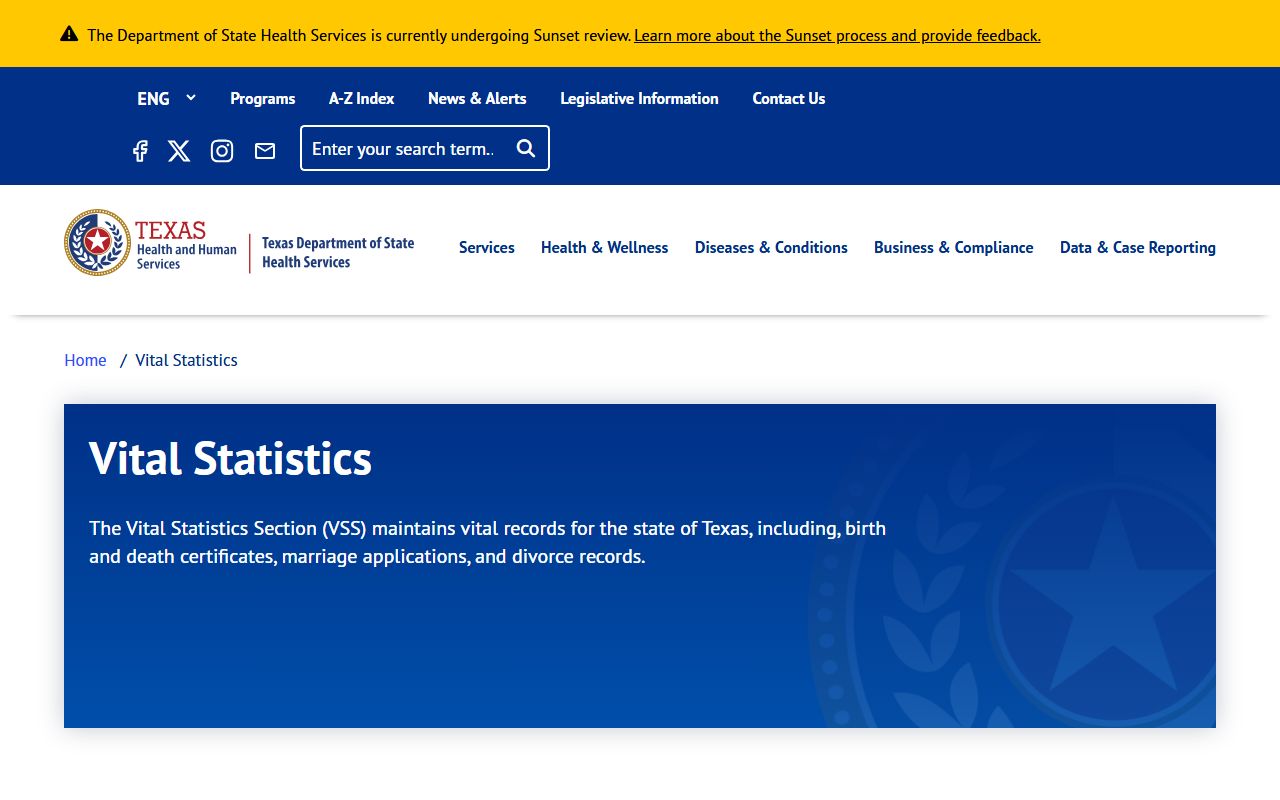
DSHS handles certified copies for events statewide and updates the central death index database as county clerks file new records each year.
How to Search Texas Death Records
Texas gives you several ways to find a death record. Online ordering is the fastest option. The Texas.gov vital records portal lets you submit requests with a credit card. Processing takes 20 to 25 business days from the date DSHS receives your complete application and payment. You can submit directly at txapps.texas.gov. The system requires valid ID, a completed application, and the correct fee. Online orders are processed through the state office in Austin. Requests for records less than 25 years old require proof that you are a qualified applicant, such as an immediate family member or legal representative.
Mail is the second route. Fill out Form VS-142, the Application for Death Record, and send it with your payment and a copy of your ID to Texas Vital Statistics, P.O. Box 12040, Austin, TX 78711-2040. The physical address is 1100 W. 49th Street, Austin. Mail-in processing averages 25 to 30 business days. For expedited service, send your request by overnight carrier or USPS Express Mail with the additional expedited fee. Payment by mail must be a check or money order payable to DSHS Vital Statistics. No personal checks are accepted at some offices. Call (888) 963-7111 to confirm accepted payment types or check on a pending order. Processing time does not include shipping time. Incomplete applications are returned unprocessed.
The third option is in person. You can visit the DSHS office in Austin or go to your local county clerk's office. The county clerk is the local registrar for deaths that occurred in that county. Some local offices can process your request the same day.
The Texas.gov Vital Records portal provides an online ordering system for death certificates and walks users through each step of the process.

The portal also handles birth, marriage, and divorce record requests, directing users to the right method based on the type of record needed.
The DSHS Order Records Locally page lists every county and city vital records office in Texas by name, making it easy to find the right local contact.
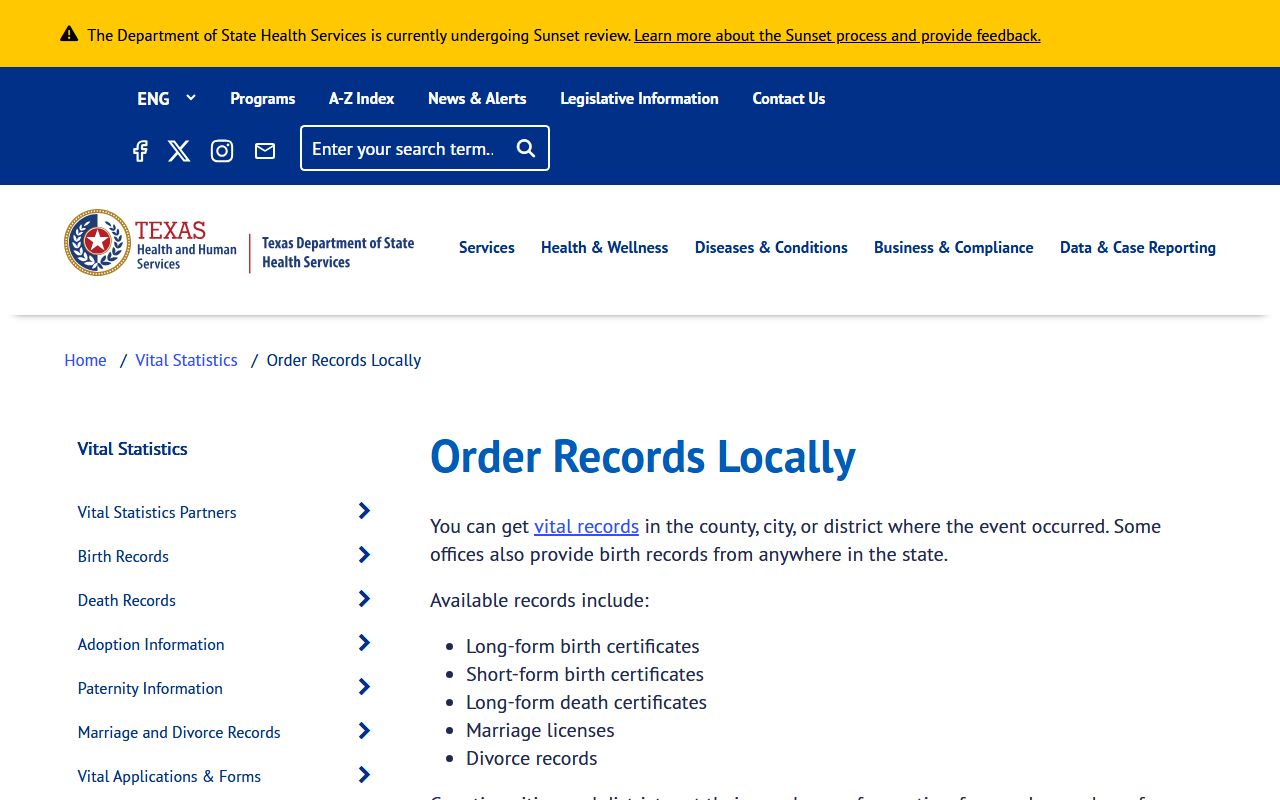
Local offices organized alphabetically by county provide an alternative to the state office when you want in-person service or same-day processing.
The CDC Where to Write for Vital Records guide for Texas confirms the state has recorded death events since 1903 and provides the official mailing address and fee schedule for the state office.
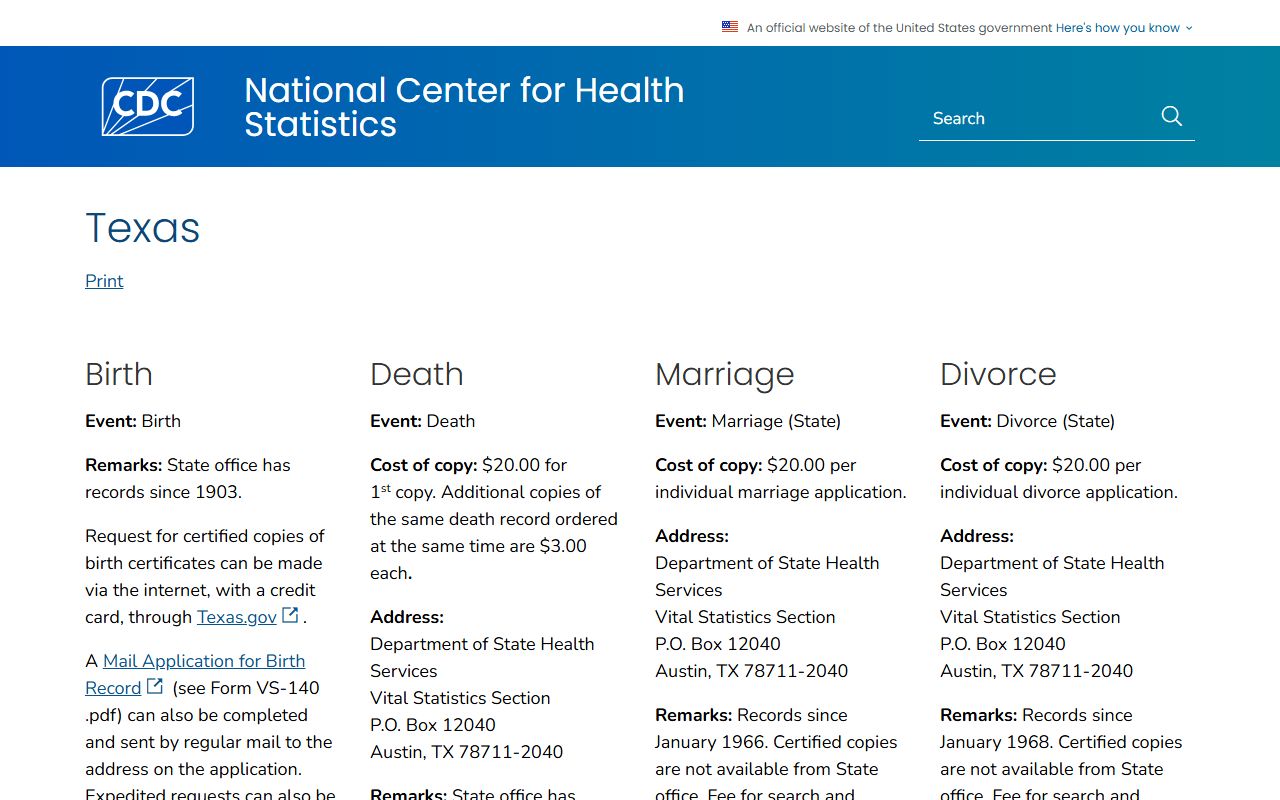
The CDC guide also notes that expedited requests sent by overnight mail are processed before standard mail orders.
Who Can Request Texas Death Records
Texas law restricts access to death records less than 25 years old. Under Texas Government Code Section 552.115, death records are confidential until the 25th anniversary of the date of death. After that, anyone can request a copy and no reason is required. For records within the 25-year window, only immediate family members and certain authorized parties can get a certified copy. The Texas Administrative Code defines immediate family as the decedent's child, spouse, parent, sibling, or grandparent. A grandchild cannot obtain a grandparent's record solely by being a grandchild. The requester must show a direct, tangible need. Legal guardians, legal representatives, and government agencies with a documented purpose can also obtain restricted records. Death verifications, which confirm that a death occurred without providing the full certificate, are available for deaths from 1903 to the present at a fee equal to the regular certificate fee. Verification letters include the name, date of death, and county where the death occurred. They are not considered legal substitutes for a certified copy.
Proof of identity is required for all requests. DSHS uses a three-group identification system. Group A includes primary IDs such as a driver's license, state ID card, military ID, US passport, or license to carry a handgun. If you don't have a Group A document, you can provide two items from Group B, which includes expired primary IDs, student IDs, Medicare cards, and DD Form 214. Group C items like utility bills, bank statements, and voter registration cards can supplement a Group B item. Mail-in requests that cannot be verified may be rejected and returned to the applicant.
The DSHS Acceptable ID page lists every accepted document type in the three-group system with clear instructions for each situation.
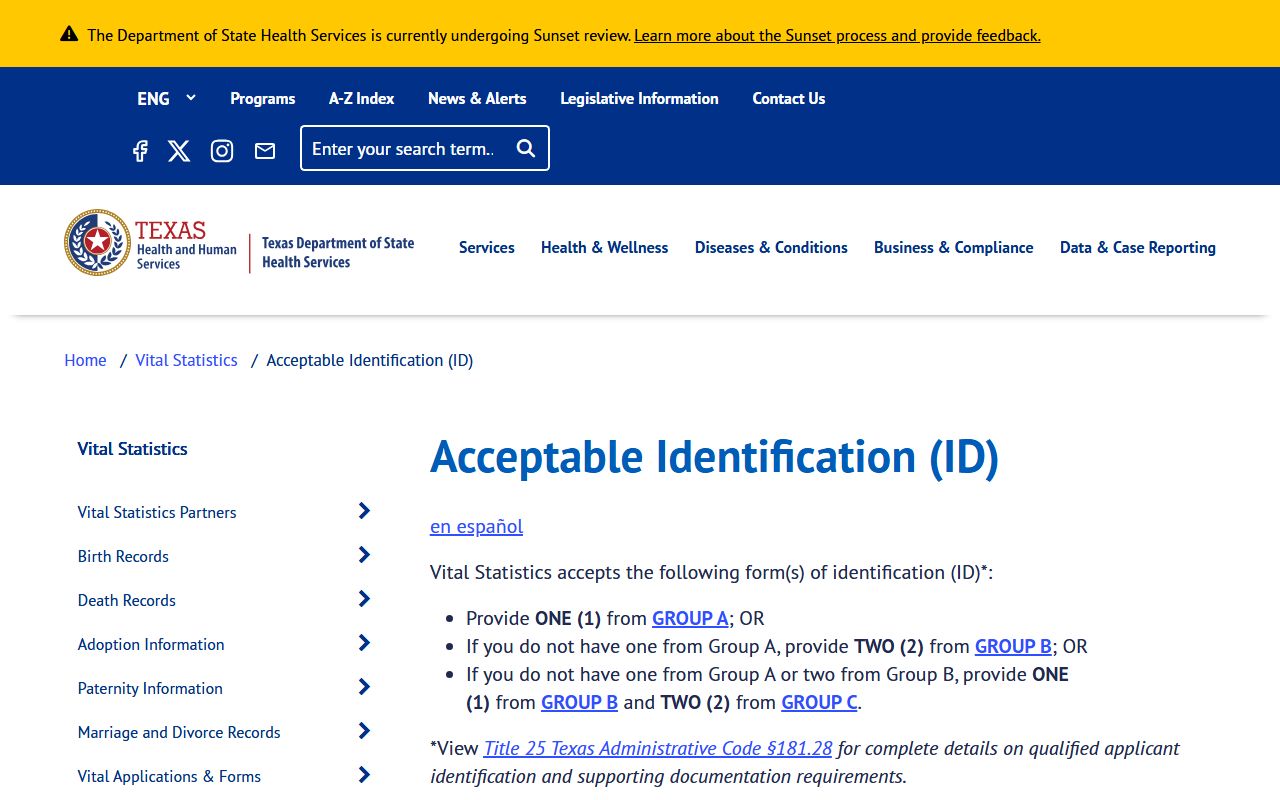
Group A primary IDs are the fastest route. Two Group B documents work when no primary ID is available, and adding Group C documents can fill remaining gaps.
Note: Records from deaths that occurred at least 25 years ago are public and available to any requester. No reason or relationship is required for those requests.
Texas Death Certificate Fees and Processing
The state fee for a certified copy of a Texas death certificate is $20 for the first copy. Additional copies of the same record ordered at the same time cost $3 each. These fees are set by the DSHS Vital Statistics Section. County offices follow slightly different fee schedules. Most counties charge $21 for the first copy and $4 for each additional copy of the same record. The breakdown at most county offices includes a search fee, a certification fee, a county clerk fee, and a vital statistics preservation fee. All copies issued by the state and county offices are certified copies. Uncertified plain copies are not issued.
State law requires that any time a search is conducted and no record is found, a search fee equal to the certificate fee is charged. That fee is not refundable. This applies at both the state and county levels. If you are searching for a record and are not certain it exists, keep this non-refundable search fee in mind before submitting a request.
The DSHS Vital Statistics mailing addresses page provides the correct address for regular requests, expedited requests, and subpoenas.
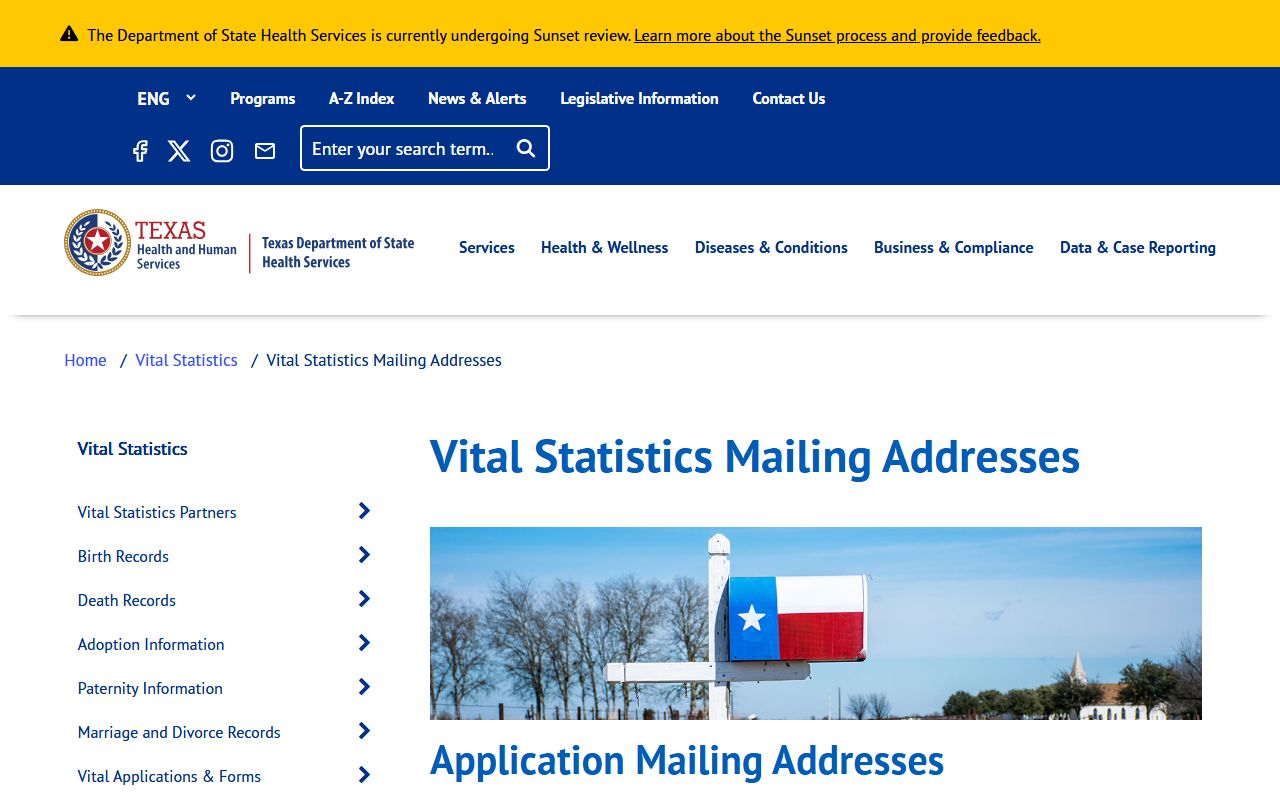
Regular processing requests go to P.O. Box 12040, Austin, TX 78711-2040. Overnight and express mail shipments go to the physical address at 1100 W. 49th Street, Austin, TX 78756.
Texas Death Records for Genealogy Research
Texas death records are a key resource for family history research. The Texas Death Index 1903-2000 on Ancestry.com is one of the largest collections available online. It contains records from the DSHS for the years 1903 to 1982. The full index covers more than 7 million individuals who died in Texas from 1903 to 2000. Fields include name, death county, death date, certificate number, gender, and marital status. Images of the original department index are available for deaths from 1903 to 1963 and 1999 to 2000. Ancestry has this collection in partnership with DSHS, making it a reliable starting point for historical research before requesting a full certified copy from the state or county office.
FamilySearch also hosts the Texas Death Index 1903-2000 at no cost. The collection was provided by Ancestry.com and draws from the same state records. Related collections on FamilySearch include Texas Deaths 1890-1976, Texas Deaths and Burials 1903-1973, and the Texas Death Index 1964-1998. FamilySearch also provides a key to Texas county codes used in older index records that identify county by number rather than name. The Texas State Library and Archives Commission holds death indexes from 1903 to 1973. These are open to public searches and can help researchers determine if a record exists before submitting a formal certified copy request.
The Library of Congress Texas vital records research guide provides an overview of death records at both the state and county levels and is a solid starting point for genealogists.
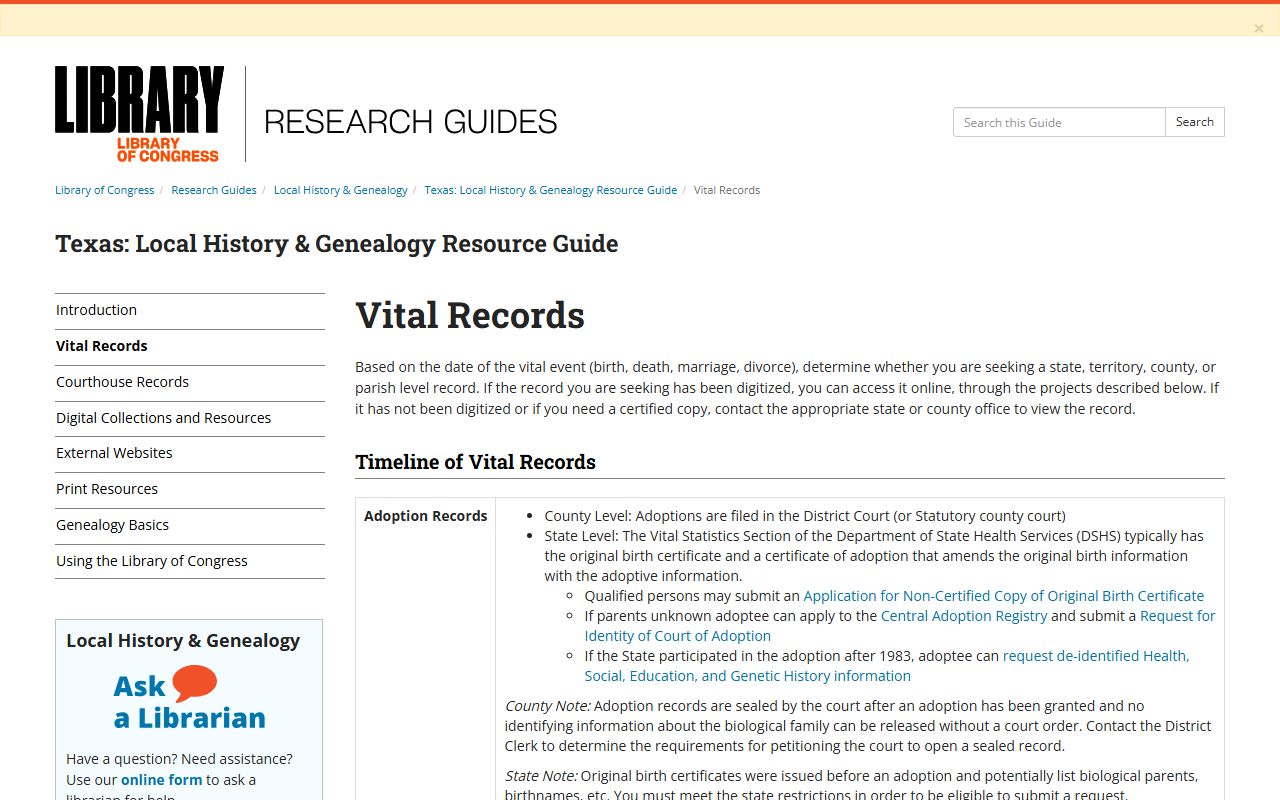
The guide notes that statewide death registration began in 1903 and that county offices hold copies of all locally registered death records independent of the state database.
The Ancestry.com Texas Death Index 1903-2000 makes it possible to search millions of records before committing to a formal certificate request.
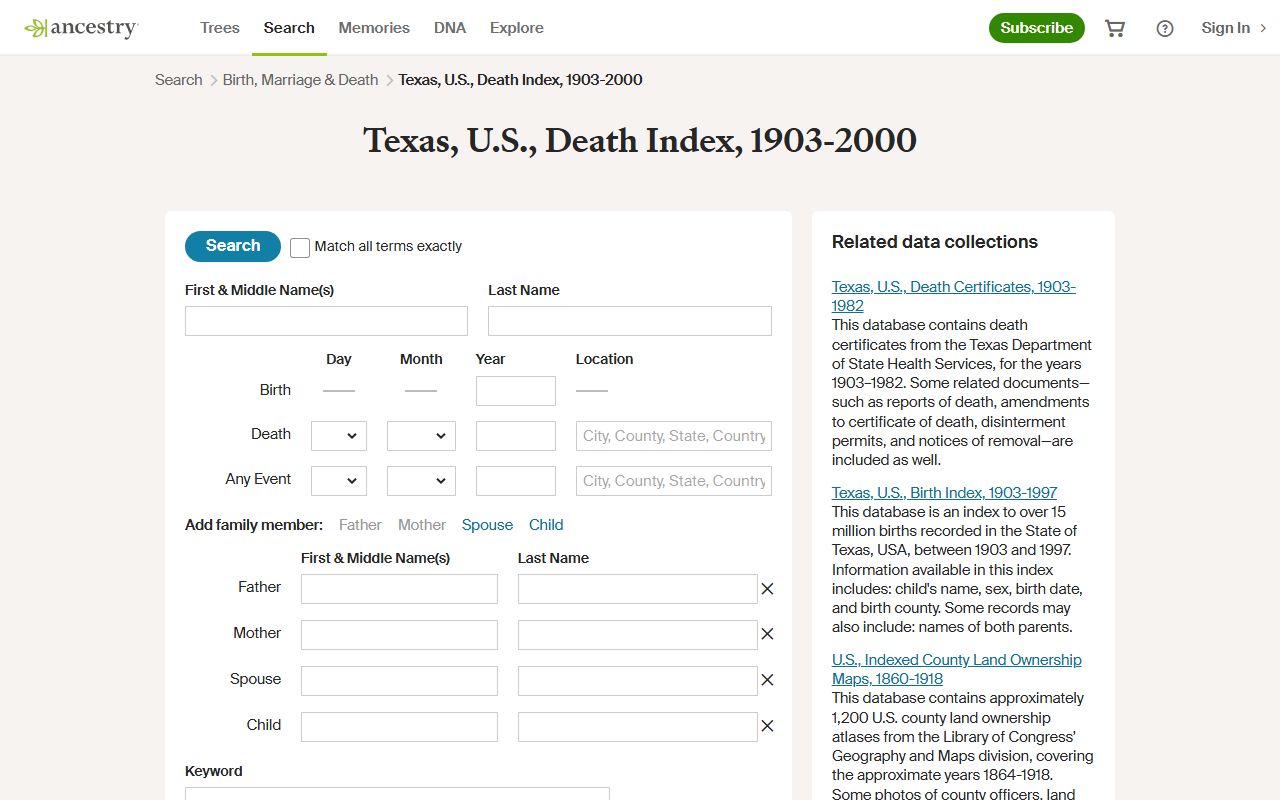
Ancestry links many index entries to images of the original DSHS index cards, which can provide additional details not captured in the searchable fields alone.
Public Access Rules for Texas Death Records
Texas death records are public after 25 years. This rule comes from Texas Government Code Section 552.115, part of the Texas Public Information Act. The law states that a death record becomes public on and after the 25th anniversary of the date of death shown on the filed record. Before that date, the record is restricted. The same law says that general death indices maintained by the Bureau of Vital Statistics are not excepted from disclosure to the extent they do not reveal adoption or paternity determinations. This means index data can often be searched without restriction even for recent deaths, but full certified copies are restricted to qualified parties within the 25-year window. County clerk records are subject to the same rules. Attorney General Opinion H-115 (1973) confirmed that the confidentiality provision applies to county-held records to the same extent it applies to state-held records.
Texas Health and Safety Code Section 191.051 authorizes the state registrar to issue certified copies to qualified applicants in the form approved by the department. Section 193.001 requires death certificates to include the county of death and the decedent's county of last legal residence. Making a false statement on a vital records application is a felony under Health and Safety Code Chapter 195, Section 195.003, carrying a penalty of 2 to 10 years in prison and a fine up to $10,000.
Texas Government Code Section 552.115 defines the 25-year confidentiality period and specifies who qualifies to request records before they become public information.
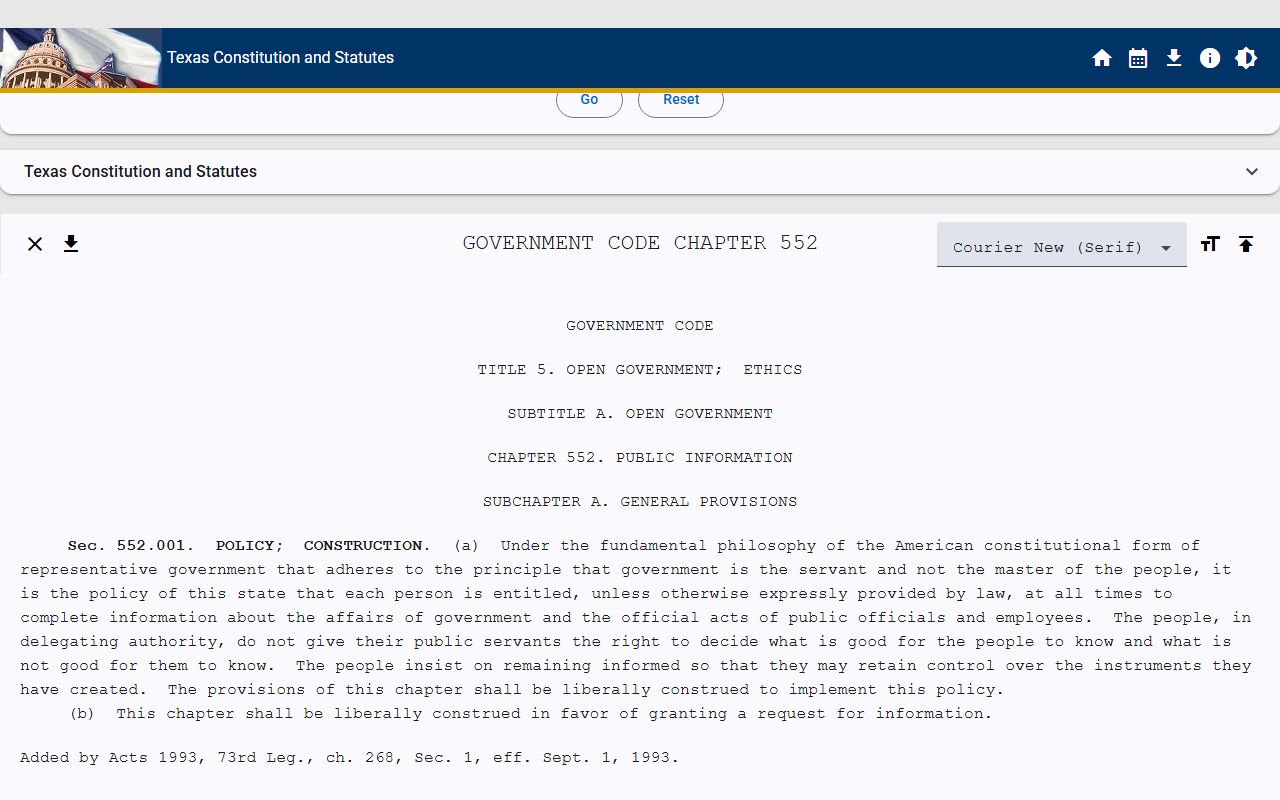
The statute applies to records held by both the state Bureau of Vital Statistics and local county clerks, creating a uniform access framework across all 254 Texas counties.
The Reporters Committee Open Government Guide for Texas covers how public records law applies to vital records including death certificates and confirms the index disclosure rules under Section 552.115.
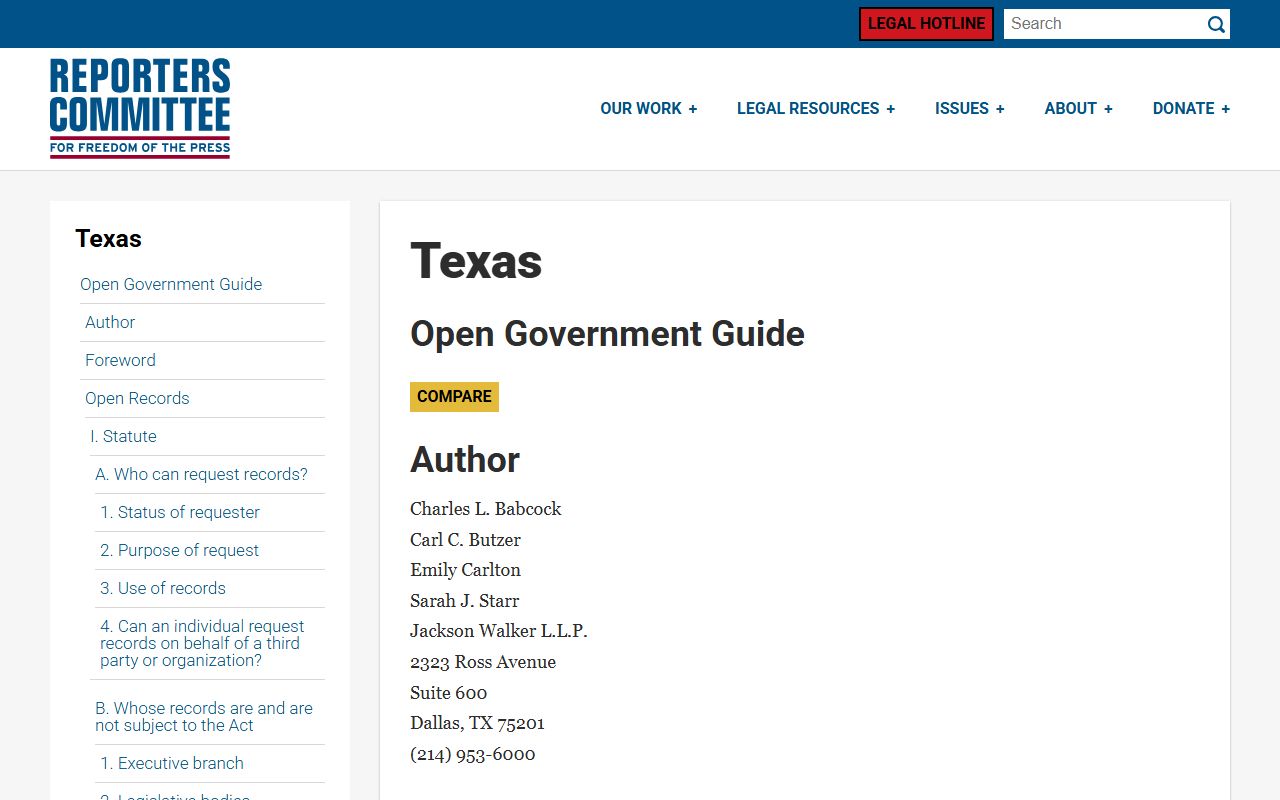
The guide also discusses the Attorney General opinions that shaped how county clerk records are treated under the same confidentiality framework as state records.
Texas Health and Safety Code Section 191.051 sets the legal basis for issuing certified copies and governs the form and conditions under which records are released to qualified applicants.
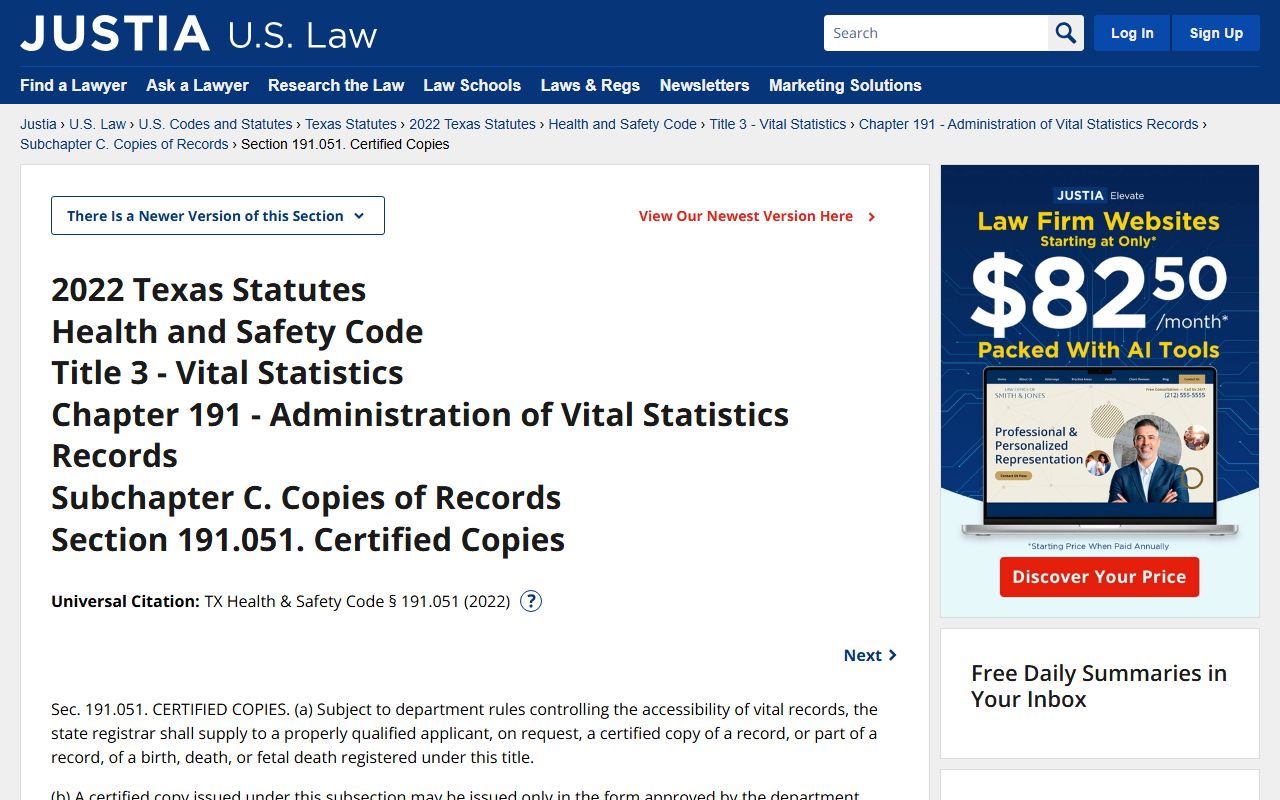
The health code also requires the local registrar to secure a complete record of each death that occurs in their jurisdiction, per Section 191.026.
County Death Records in Texas
The county clerk in each Texas county serves as the local registrar for deaths that occur within that county. There are 254 counties in Texas, each with its own county clerk's office. The clerk files the original death certificate, keeps a local copy, and forwards a copy to the DSHS Vital Statistics Section in Austin. You can request a certified death certificate from either the county clerk where the death occurred or from the state office. Fees are similar but may differ. The state charges $20 for the first copy. Most counties charge $21. Local offices listed in the DSHS local directory can help you find the right office for your request. Some counties offer online ordering through their own portals or through state-approved services. Others take requests only by mail or in person.
Each county operates on the same legal framework but may have different local procedures. Processing times at the county level can be shorter than the state office for in-person requests. Travis County, for example, holds death records for events within Austin city limits and within Travis County only from 1903 to 1956. After that, city registrars took over for events within the Austin city limits. Tarrant County handles records for most of the county but refers deaths in Arlington from 1971 forward and Grapevine from 1973 forward to those city halls. Always confirm with the specific county clerk before submitting your request.
The Tarrant County Clerk vital records page illustrates how a large Texas county manages death certificate requests, including accepted payment methods, ID requirements, and available ordering channels.
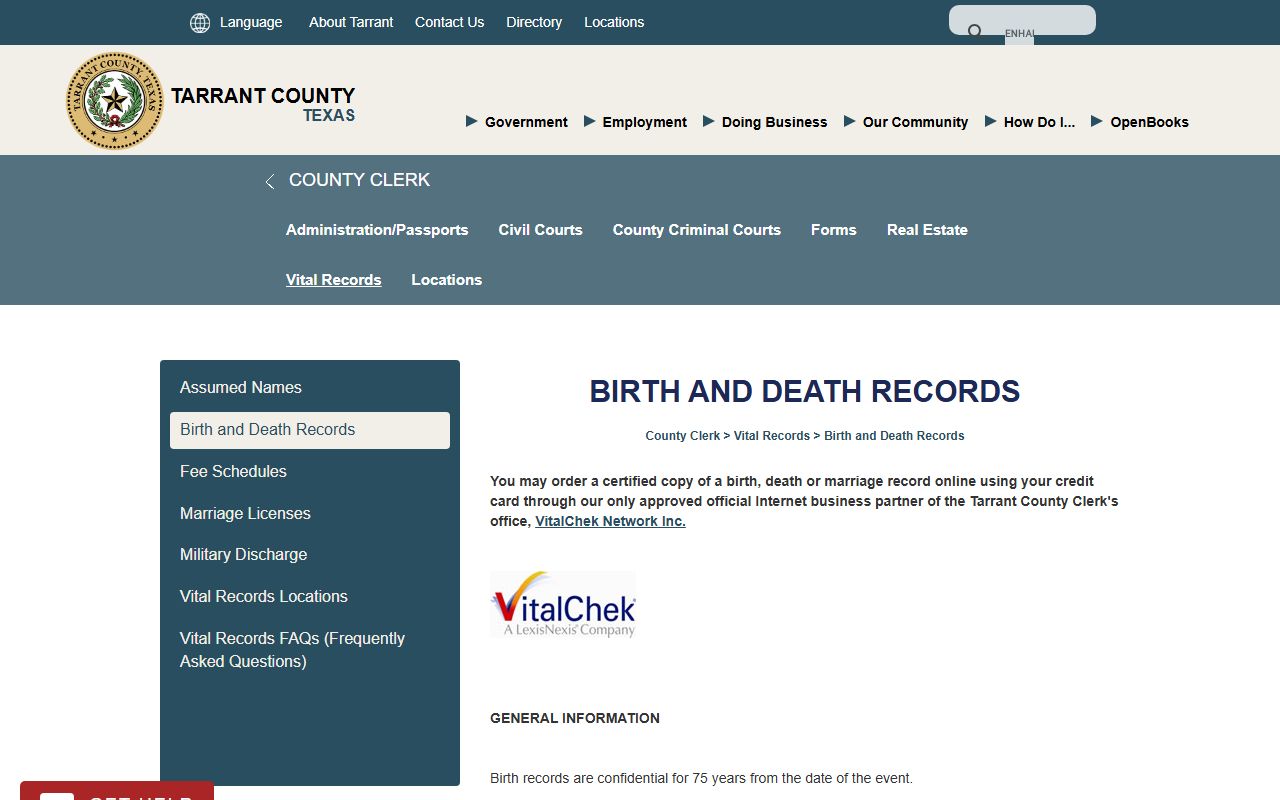
Tarrant County charges $21 for the first certified death certificate copy and $4 for each additional copy purchased at the same time. All copies issued are certified copies.
The Travis County Clerk vital statistics page shows how county clerk record availability can vary based on local registration history and which registrar handled events at different points in time.
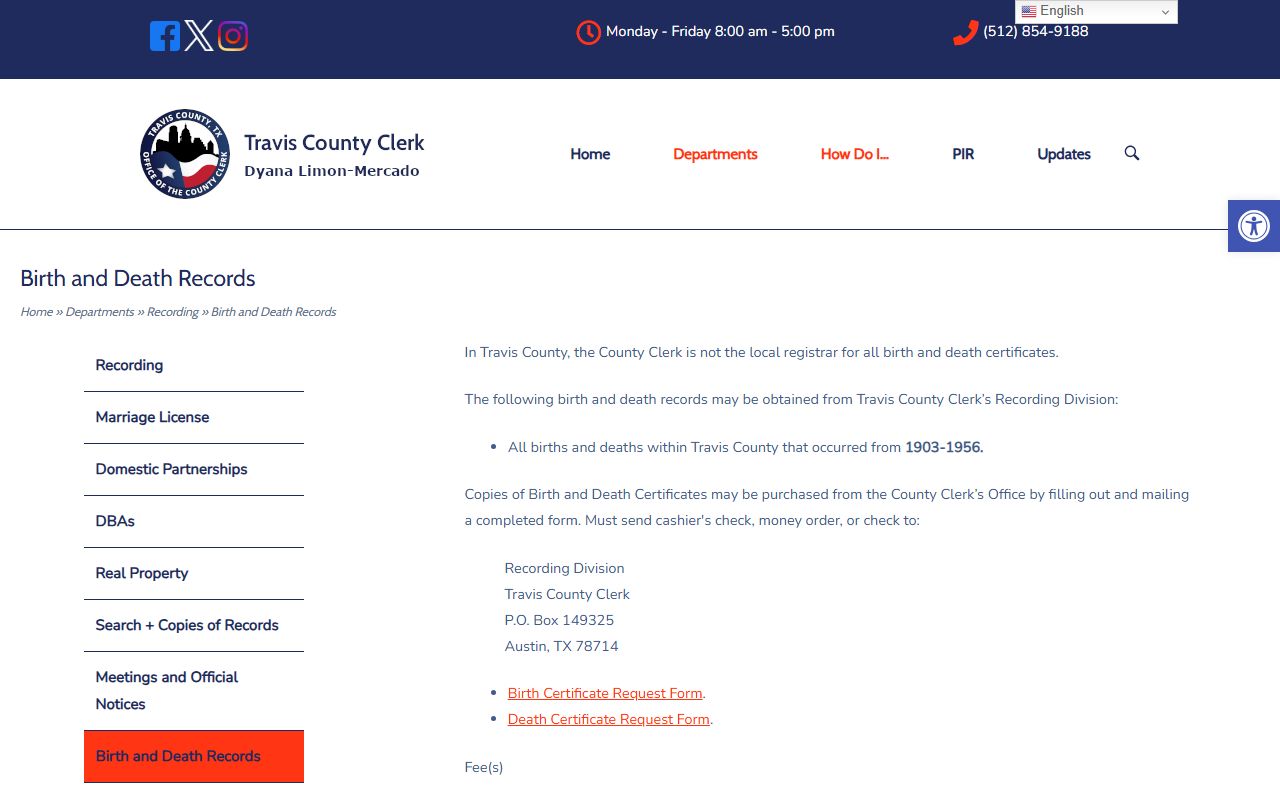
Travis County charges $20 for a certified death certificate copy. For deaths after 1956 within Austin city limits, requests go to the Austin City Clerk's Vital Records Office instead.
Note: When you are not sure which office holds the record you need, the DSHS Vital Statistics Section at (888) 963-7111 can direct you to the correct local registrar.
Browse Texas Death Index by County
Texas has 254 counties, each with a county clerk that serves as the local registrar for death records. Select a county below for contact information and local resources for the Texas death index in that area.
Texas Death Index by City
Major Texas cities file death records through the county clerk or a local city vital records office. Select a city to find where death records are kept in that area.