
Tarrant County Death Index
Tarrant County death records are filed with the County Clerk in Fort Worth and go back to 1903. This page explains how to search the Tarrant County death index, get certified copies of death certificates, understand who can access records, and find related resources for genealogy and legal purposes. Whether you need a recent record or are digging into older death records, the Tarrant County Clerk handles requests in person, by mail, and through an online ordering partner.
Tarrant County Overview
Tarrant County Clerk Death Records
The Tarrant County Clerk's office in Fort Worth handles vital records, including death certificates, for all of Tarrant County. The main office is at 200 Taylor Street, Suite 301, Fort Worth, TX 76196. You can reach them by phone at 817-884-1550. Office hours are Monday through Friday, 8:00 AM to 5:00 PM. The Tarrant County vital records page has current forms and ordering instructions.
There is an important detail about death records in Tarrant County. If a death occurred in Arlington from 1971 to the present, or in Grapevine from 1973 to the present, the Tarrant County Clerk does not hold those death records. You must contact the appropriate city hall for those events. For all other deaths in the county, the Tarrant County Clerk is the right place to go. This county-vs-city split is uncommon but it matters if the person died in one of those two cities.
Tarrant County also offers online ordering through VitalChek, which is the only approved official internet partner of the Tarrant County Clerk's office. This is the fastest option if you cannot make it to Fort Worth in person. The county also has subcourthouse locations throughout the area, which can be useful if you live far from the main office in Fort Worth.
Note: Always confirm whether the death occurred in Arlington or Grapevine before submitting a request to the county clerk, as the clerk has no access to death records from those cities after the dates listed above.
The Tarrant County Clerk vital records page outlines the process for getting certified death certificates, including the VitalChek online option and in-person procedures at the Fort Worth courthouse.
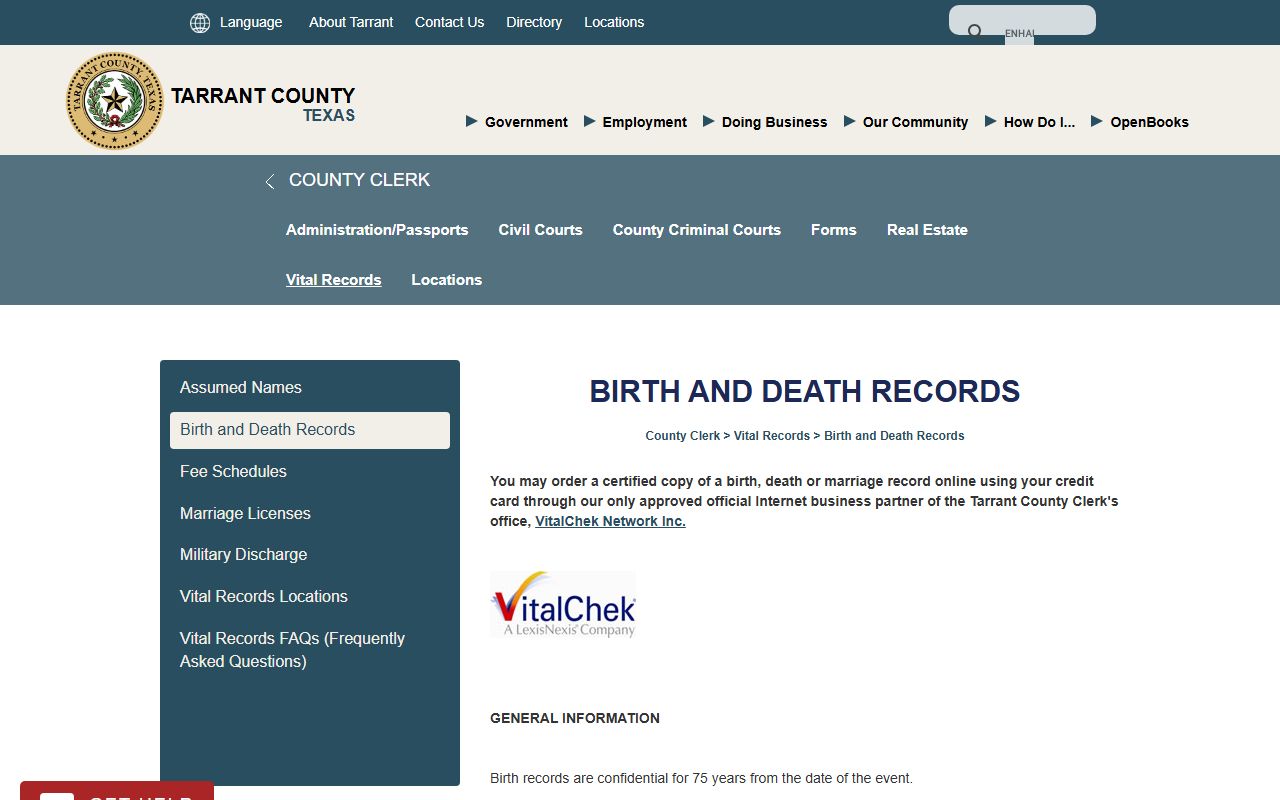
This page covers fees, acceptable ID, and the city-specific exceptions for Arlington and Grapevine death records.
How to Get Tarrant County Death Certificates
You can get a death certificate from Tarrant County three ways. In person is the fastest. Go to 200 Taylor Street, Suite 301, Fort Worth, TX 76196 during business hours. Bring a valid government-issued photo ID and the required fee. The clerk can search by the decedent's name and approximate death date and issue certified copies the same day.
Mail requests are also accepted. Fill out the death certificate request form, include a copy of your photo ID, and send a check or money order payable to the Tarrant County Clerk along with your request. Mail to 200 Taylor Street, Suite 301, Fort Worth, TX 76196. Allow several business days for processing after the office receives your request. Mail-in requests take longer than in-person visits, so plan accordingly if you have a deadline.
Online ordering is available through VitalChek. This is the county's only approved online partner. You will need a credit card and valid ID information. Orders placed online are mailed to you after processing. If you prefer to order through the state rather than the county, the Texas vital records online system at DSHS also accepts death certificate requests for Texas deaths.
Tarrant County Death Certificate Fees
Tarrant County charges $21.00 for the first certified copy of a death certificate. Each additional copy of the same record, ordered at the same time, costs $4.00. All copies issued by the county are certified. This fee structure follows the standard Texas county rate set by state law and applies to all requests, whether in person, by mail, or online through VitalChek.
If you order through the Texas DSHS state office in Austin instead, the fee is $20.00 for the first copy and $3.00 for each additional copy. The state fee is slightly lower but the processing time is longer. State orders are mailed from Austin rather than issued at a local office. For most people in Tarrant County, using the county clerk or VitalChek is faster. The state route makes more sense if you are ordering from out of state and mailing time is not a concern.
No fee is refunded if a search is done and no record is found. Texas law requires that a search fee equal to the certificate fee be charged even when the record does not exist or is not found. Keep this in mind before submitting a request for a record you are unsure about.
Who Can Access Tarrant County Death Records
Texas restricts access to death records that are less than 25 years old. Only qualified applicants can get certified copies during that window. A qualified applicant is an immediate family member of the person on the record. That includes a spouse, parent, child, sibling, or grandparent. A legal representative of the family can also request records with proper documentation.
Tarrant County notes one additional nuance for grandparent-grandchild requests. A grandparent may obtain their grandchild's record. However, a grandchild cannot obtain their grandparent's record without providing proof of a direct tangible need. This is slightly more specific than the basic immediate family rule. If you are a grandchild requesting a grandparent's death certificate that is less than 25 years old, you will need to show why you need it.
After 25 years from the date of death, the record becomes public. Anyone can request a copy at that point. This rule comes from Texas Government Code Section 552.115. All requesters must show valid government-issued photo ID regardless of whether the record is restricted or public. Acceptable forms include a driver's license, state ID, U.S. passport, or military ID.
Making a false statement to obtain a death certificate is a felony under Texas Health and Safety Code Chapter 195. The penalty is 2 to 10 years in prison and a fine of up to $10,000. Every transaction is documented with the requester's identity.
Historical Death Records in Tarrant County
Tarrant County death records go back to 1903, when Texas began statewide mandatory registration of deaths. The county covers a large population and the records are substantial in volume. For genealogy research, older records from the county are well worth searching. Statewide death indexes are available through free online resources that cover much of the Texas historical record.
The FamilySearch Texas Death Index covers records from 1903 to 2000 and is free to use. Ancestry's Texas Death Index covers a similar range and includes over 7 million individuals who died in Texas during that period. Both are index-only databases that provide the decedent's name, death county, death date, and certificate number. You can use these to narrow down a search before requesting a certified copy from the county. The Library of Congress Texas vital records guide also explains how to navigate the Texas death record system for researchers.
The Texas State Library and Archives has death indexes from 1903 to 1973 available for public search. These microfilmed indexes are also held at several genealogical libraries around the state. For deaths in specific cities like Fort Worth, city-level records may supplement what is in the county index.
The DSHS Order Records Locally page lists county clerk offices across Texas, including Tarrant County, where you can get certified death certificates in person or by mail without going through the state office in Austin.
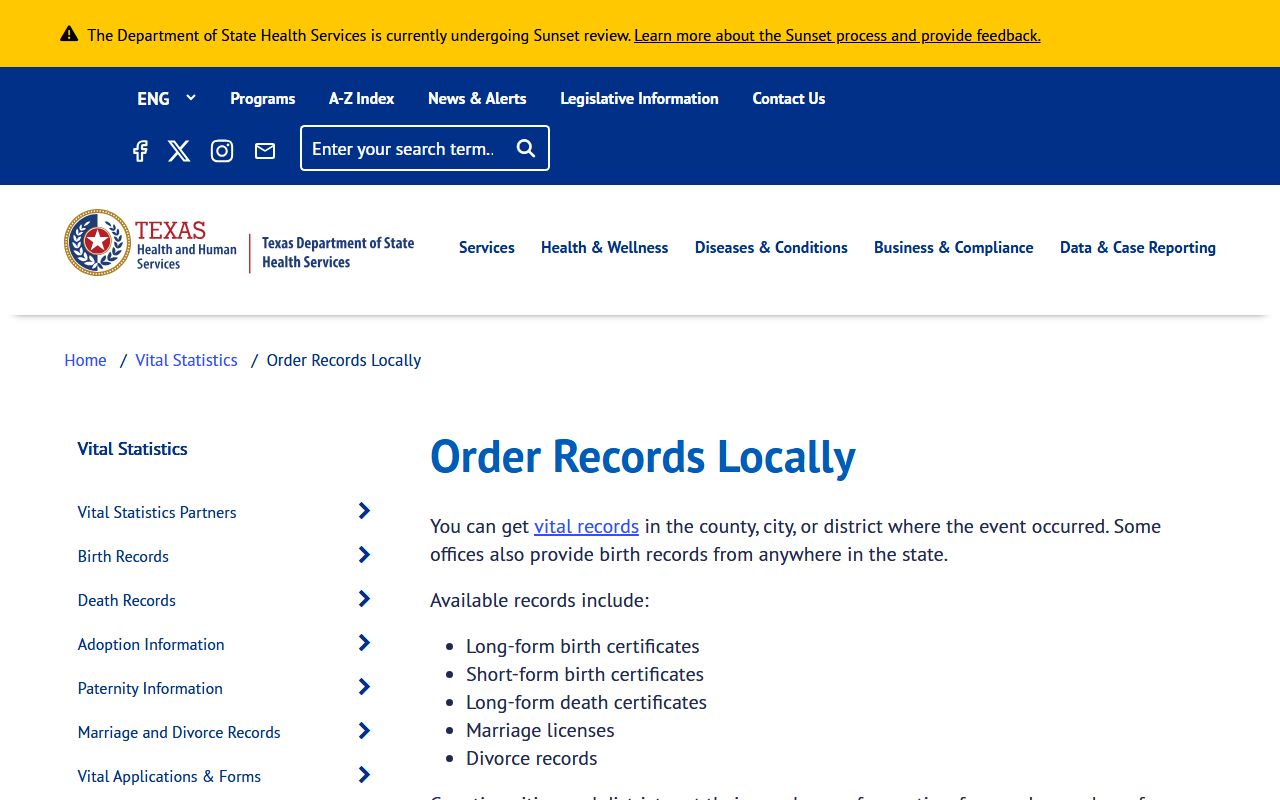
Tarrant County is one of the larger county offices on this list, processing a high volume of death certificate requests each year.
Cities in Tarrant County
Tarrant County is home to Fort Worth and several other large cities. Death records for most events in the county go through the Tarrant County Clerk, with the exception of Arlington deaths from 1971 onward and Grapevine deaths from 1973 onward, which are held by those city halls.
Other communities in Tarrant County include Grapevine, Haltom City, Euless, Bedford, Colleyville, Keller, and Southlake. Death records for these areas generally go through the Tarrant County Clerk, except where noted above.
Nearby Counties
These counties border Tarrant County. If you are uncertain which county a death was registered in, the county where the death occurred is listed on the death certificate itself.
Dallas County • Denton County • Wise County • Parker County • Hood County • Johnson County • Ellis County